Services
- here to help -

Speech
the sounds
Does your child frequently...
simplify
substitute
or omit
sounds?
This may result in requests for repetitions from listeners,
or may make them sound younger than their age.
Ella uses visuals, modelling, dynamic feedback, and cognitive reframing to teach or reshape sounds and expand usage from words to phrases to sentences. She uses explicit instruction on how you use your speech mechanism to turn on and off your vocal cords, restrict or release airflow, and use your lips, teeth, and tongue to produce the ~44 sounds we have in English.
"top" instead of stop
"wed" instead of red
"baw" instead of ball
Language
the meaning
Does your child use fewer words than expected or generate shorter or grammatically incorrect sentences?
Do they struggle to follow instructions, share information, or ask/answer questions?
Reduced understanding of what words mean and how they can be used could be the underlying cause.
e.g., bare tree vs. bear in a tree
(these sound close, but mean something very different!)
Ella uses highly interactive and memorable vocabulary, morpheme, and narrative exercises to broaden and strengthen language understanding (receptive) and language use (expressive).


Literacy
reading & writing
the next level skills
Successful literacy development is dependent on a solid foundation of speech and language skills. That's what makes Speech-Language Pathologists uniquely equipped to address reading and writing impairment.
When your child reads out loud, do they sound choppy
and effortful?
Do they frequently misread common words?
e.g. "the", "is" vs. "in"
Do they often seem to substitute or omit letters?
e.g., "cat" instead of cot, or "sam" instead of stamp?
Are they challenged by longer, multisyllabic, words?
e.g., "pancake" or "Zamboni"
Ella uses structured literacy intervention to establish a sturdy foundation of phonological awareness and letter-to-sound knowledge (phonics), and then builds upwards from there. She integrates reading and spelling activities to help kids increase their accuracy, speed, and ultimately, confidence.
Communication
survive & thrive
Let's look at the context, audience, and goals.
Across contexts, we benefit from communicating our basic needs (like cold, hunger, or fatigue).
At school, we benefit from communicating when we don't understand or need help from teachers.
When a context or person makes us feel a BIG emotion, we might want to express it so that it will continue or stop.
With our friends at recess, we may want to share our likes, dislikes, and experiences to grow closer.
With a new person, we might want to find a point of connection.
But communication is not a one-size-fits-all. Ella is dedicated to finding the communication goals and approach that are the right fit for your individual child.
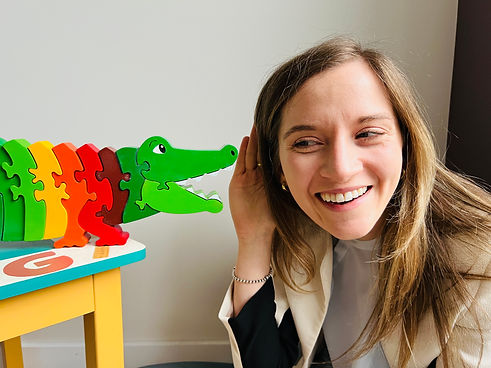

Toddler & Preschooler Groups:
Enriched Storytime
Join Ella for a parent & child group read alouds
on Tuesdays at 9:30am!
Huddle up and listen close...
When you do storytime with a Speech-Language Pathologist, you'll learn new words, practice the sounds letters make, dive deeper into narrative, connect what you've read to the outside world, and start intentionally building up your pre and early literacy skills —
and you might even make some new friends along the way!
March 2026 Session Dates: Mar. 3, Mar. 17, Mar. 24, Mar. 31
*NO session on Mar. 10
April 2026 Session Dates: Apr. 7, Apr. 14, Apr. 21, Apr. 28
or
- Eligible for insurance claim. You will receive a receipt to submit for reimbursement. *Note that the amount of coverage annually or for group sessions varies from plan to plan: please consult your provider or benefits guide.
- Part of a growing family? Siblings can attend at 50% off and babies under 1 year-old can attend for free.
- Unfortunately, the Avid office is not stroller accessible, and requires mobility for 12 stairs.
Literacy with Ella, a Speech-Language Pathologist (SLP)

EXPERT
Successful literacy development is dependent on a solid foundation of speech and language skills.
As their title suggests, Speech-Language Pathologists are uniquely equipped to ensure that foundation is solidly in place.

EXPERIENCED
SLPs are well versed in working with and facilitating independence in children with diverse needs or learning challenges.

EVIDENCE-BASED
Ella's intervention is informed by her Certificate of Advanced Study in Literacy & Language from the Massachusetts Institute of Health Professions and her training in Orton-Gillingham from the Institute of Multi-Sensory Education.

INDIVIDUALIZED
Ella can flexibly modify and expand on the general principles of high-quality literacy instruction to meet your child's individual needs.